
What is your imperative?
I come not to praise a dichotomy but to bury it.

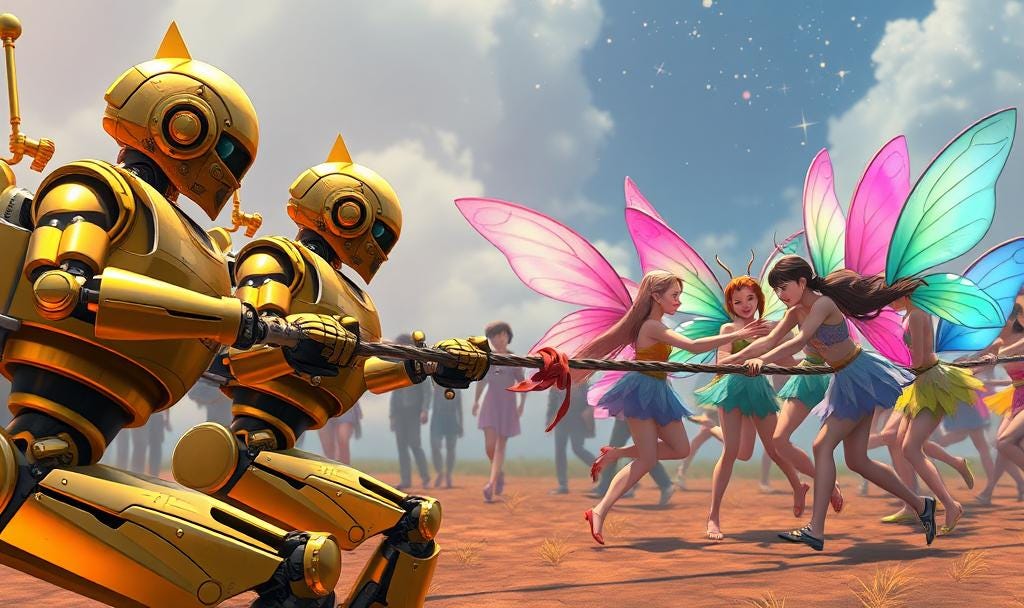
Dichotomy or Duality?
In life and story as in politics, humans love binaries. They’re clean. They’re simple. They’re silly. They cause drama. They lead to all-or-nothing thinking. Show me a dichotomy and I’ll denounce its tyranny!
But I digress.
Very few things in my experience can actually be devolved into black-white, yes-no, one-zero, on-off pairs of values. They may simplify decision-making for you. If you need that to get through your day or a tough emotional situation, I get it. I won’t judge you…too harshly.
However, a more useful way to think about everything is a duality or a spectrum. For example, plotters versus pantsers is often presented as a dichotomy by writing gurus (who’re trying to sell you something), but in reality, every author is both. The most inveterate outliner can’t possible detail everything she writes into a scene—or the novel itself is the outline. The most diehard pantser has to end up with a working plot in his book—or the novel itself is broken. (No, it’s not lost on me that I’m also—sort of—trying to sell you something.)
So, too, is the commercial versus literary dichotomy, or as I prefer to think of it, the duality of written art: the stalwart, time-tested Commercial Imperative and its elegant, artistic mate the Expressionist Imperative.
Let’s take a look at the extremes of the duality and the rainbow in between.
The Commercial Imperative
It’s entirely possible that you have zero interest in making money from your written words. If that’s the case, I do have to wonder how you arrived at this particular place talking to me, of all people. I have never had a paying client who simply wanted to learn how to write a great book to give it away for free. Don’t get me wrong, I’m happy to take clients like that—I’ve just never had one. Yet. (Bring me yo’ money! Heh.)
This means that every client I’ve had (so far) would not turn down money in exchange for a copy of their story. To one degree or another, they abide the commercial imperative. Something about their work must be constructed or shaped to present in such a way as to be valuable in the marketplace and to other people.
In many ways, I admire the hobbyists who write only for themselves. They can produce with no constraints for the simple joy of making art. However, even amongst the hobbyists, I have met none who don’t want other people to read their work and appreciate it. That is the simplest form of the commercial imperative.
Validation is the least expensive and most valuable coin.
In order to obtain validation, you must produce something that the audience can recognize and appreciate, and you must publish it somewhere that enables you to collect the validation, in lieu of or in addition to money.
As soon as you begin to ask for or seek out the approval of others in the form of stars or dollars, you are abiding the commercial imperative—even if you don’t request money—because you must begin to consider audience, brand, voice, market, and all of the other idiosyncrasies that differentiate one type of story from another. (Hint: those differentiators are called genres and tropes. Even the most literary of fiction has *gasp* genres and tropes in them.)
If you’re writing for people who appreciate horror stories or love stories, you must meet their expectations (in an unexpected way), or you won’t get the appreciation you expect. And, so too, with money. You have one job, whether they pay you with likes or cash: Your job is to satisfy your intended audience.
The commercial imperative rests upon one foundation: Who are you writing for?
In fact, I have a whole post about that:
The Expressionist Imperative
On the flip side of the commercial imperative, if you like the coin metaphor, are the other nonnegotiables: the artistic ones. But since we’ve moved to the other end of the duality, away from the commercial imperative, let’s call this spectrum a rainbow. Maybe there’s a gold-plated unicorn at the end of it, or something. I’ll quit torturing the metaphor. In a minute.
Just like every client I’ve ever had wouldn’t turn down money in exchange for a copy of their magnum opus, there are also THINGS THAT THEY WILL NOT WRITE. Yes, that’s loud. You can always tell when you touch someone’s no-noes…they get noisy. Sometimes it’s just the disgust on their face. “Eww! I will not write a kissing book!”
Sometimes it’s a whisper. “No, that’s too scary. Now, I don’t want to write that anymore. I need to go lie down.”
Or sarcasm! “Of course, I would ‘adore’ to pretend to be in high school all over again for a year while I write an entire book set in a magical academy.” Cue the eyeroll.
It doesn’t really matter what the nonnegotiable is. It doesn’t matter whether you believe it’s a moral imperative or a creative imperative underlying your expressionist imperative. All that matters is that you be honest with yourself about yours. The entire point is that they are your unique choices about what you will and will not write.
However!
Every one of your nonnegotiables at the rainbow end your expressionist imperative will necessarily limit your potential audience. Every. Single. One.
Let’s say, if you want to write a cozy mystery, that’s one nonnegotiable. People who love thrillers or courtships may not prefer to read cozy mysteries and probably won’t pick up your book. That’s to be expected. You shrug. So?
Then, if you want your amateur sleuth in your cozy mystery to be a witch, you’ve entered the paracozy niche and left behind a nontrivial chunk of cozy mystery readers who don’t want to read about witches and magic being used to figure out who killed Aunt Netty. OK. You get that.
Then, if you decide that your protagonist is a Sexy Grandpa Witch who’s having relations (on the page!) with one or more of his neighbors and coven members, you’ve violated a typical expectation of the broader paracozy audience, who prefer no sex or closed-door sex, and also generally prefer grandmotherly amateur sleuths over grandfatherly ones. (I see those of you who’ve already noped out at this point. It’s OK.)
The point is that every artistic choice reduces your potential readership, but your expressionist imperative demands the Sexy Amateur Sleuth Grandpa Witch!
Every time you make something nonnegotiable, you’re going to reduce your potential audience. Even if (especially if) you insist on actually using your thesaurus to put $50 words on every page to prove how smart you are. But I digress. Again.
What does the duality mean?
This post is my long-winded love letter to my clients to say that you can write whatever you want: it can be both commercially viable (or not) and artistically authentic (or not). Just remember that every single choice or lack of a choice adds up.
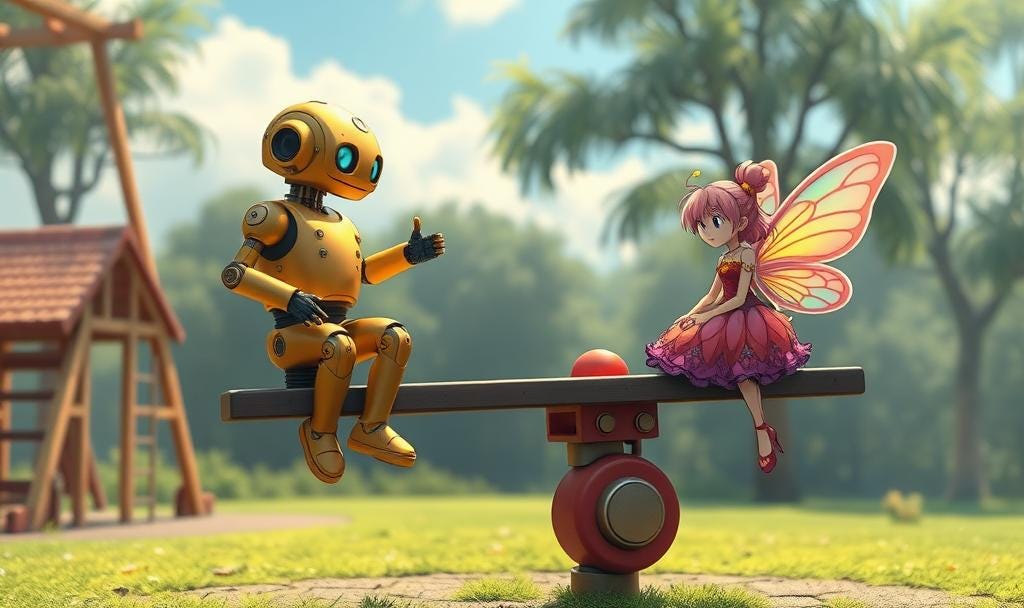
While there’s still a lot of luck and timing and other factors outside your control in the marketplace run by Loki, there is a sliding scale or a playground seesaw. You are the only one who can decide where to start and stop along the rainbow or where to tip the seesaw. (No, I have not written the golden robot and rainbow fairy love story. Yet.)
If you want more money and validation, you’re probably going to sacrifice some artistic license to gather an audience who will recognize what you’re doing and pay for it or give it five stars.
If you want more autonomy and critical acclaim, you’re probably going to have to sacrifice some sales in order to be further from the mainstream and true to whatever your vision is or what the Muse calls you to produce.
You must choose and you must be honest with yourself about what you’re choosing along the spectrum between the commercial imperative and the expressionist imperative. If you’re not honest with yourself about the story decisions you’re making and which end of the spectrum you intend to favor, then you’ll be surprised and probably sad about the outcome.
The golden robot and the rainbow fairy both want you to be happy.
What’s next?
If you’re looking to develop your skills as an author, novelist, or writer, consider joining me in the next Story Grid Writer Mentorship Program. We develop in-depth storytelling skills begin with developing scene-level writing master at level one then progresses through short story craft at level two and on to building a complete novella or novel at level three. The Writer Mentorship provides a supportive community of students and mentors and a curriculum that is tailored to each individual student.
If you’re looking to develop your novel for publication, either through traditional press or as an indie, consider hiring me to be your book shaman. Wherever you choose for your work to land on the imperative rainbow, I’m here to help you tell the best story you can. I’m your huckleberry.
Want help with your story?
If the Nine Circles of Revision Hell seem daunting to you, you’re not alone. They can be a slog, even when you’ve done them many times. For a lot of writers, the editing process is the most painful part of publishing. I’m weird. I enjoy it! But I’m aware that not everyone does. If you don’t get off on revisions or if you don’t even know where to start, let me help you.

I’m a Story Grid Certified Editor and founding member of the Story Grid Guild. I’ve been helping my clients with developmental editing of their novels and screenplays as well as chapter-by-chapter scene coaching for their works-in-progress since 2020. I joined the staff of the Story Grid Scene Writing Workshop as a coach in June 2024 and the Story Grid Writer Mentorship cadre as a mentor in January 2025.
I’m available for hire. Book a campfire chat and let’s see if we might be compatible story adventuring companions.